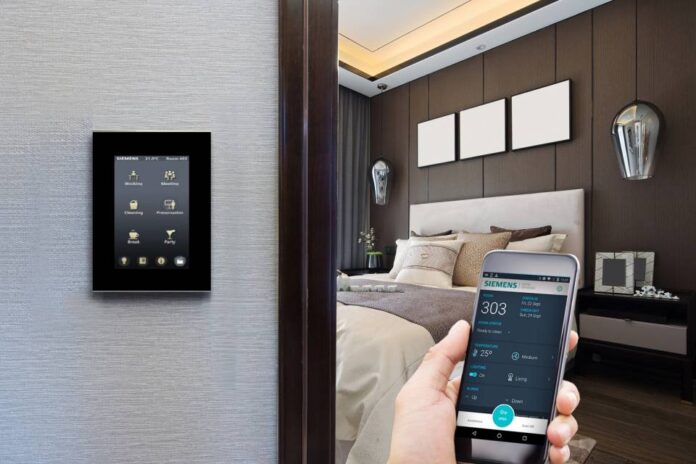
The hospitality industry is undergoing a paradigm shift from simple accommodation to “connected living.” Smart hotels are no longer just about high-speed Wi-Fi; they are sophisticated ecosystems where IoT (Internet of Things), AI, and data analytics converge to create hyper-personalized guest experiences and operationally efficient assets.
For business leaders and investors, the “Smart Hotel” is not merely a trend but a critical competitive differentiator. The global smart hospitality market is projected to grow from $45.2 billion in 2025 to $330.2 billion by 2035, driven by a compound annual growth rate (CAGR) of roughly 22%.
1. The Core Technologies of a Smart Hotel
A smart hotel relies on a “digital nervous system” that connects guest-facing apps with back-end operations.
Guest-Facing Innovations
- Mobile-First Ecosystem: The guest’s smartphone is the remote control for their stay. This includes mobile check-in/out (bypassing the front desk), digital room keys (NFC/Bluetooth), and in-room controls for lighting, temperature, and blinds.
- Voice & AI Assistants: In-room assistants (like Amazon Alexa for Hospitality) allow guests to request towels, order room service, or ask for local recommendations via voice commands, reducing friction and front-desk call volume.
- Hyper-Personalization: AI analyzes guest data (past stays, dining preferences) to automatically adjust the room temperature to their liking upon arrival or suggest personalized itineraries.
Operational Technologies (The “Hidden” Efficiency)
Robotics: Service robots are increasingly used for room service deliveries, vacuuming corridors, and even acting as concierge assistants, freeing up human staff for high-touch interactions.
IoT & Energy Management: Smart sensors detect occupancy. If a guest leaves the room, the HVAC system automatically enters “eco-mode” and lights turn off, potentially reducing energy costs by 10-30%.
Predictive Maintenance: IoT sensors on critical equipment (boilers, elevators, AC units) detect anomalies before failure, allowing maintenance teams to fix issues proactively rather than reactively, preventing guest complaints.
2. Business Case: ROI and Operational Efficiency
Implementing smart technology is a capital-intensive strategy that yields long-term operational savings and revenue uplift.
| Investment Area | Estimated Cost | Business Impact / ROI |
|---|---|---|
| Smart Room Upgrade | $1,000 – $5,000+ per room | Higher ADR (Average Daily Rate), energy savings of 10-30%, improved guest satisfaction scores. |
| Tech Infrastructure | ~$66,500 (Year 1 for avg hotel) | foundational requirement for scaling; enables data collection for personalization. |
| Cybersecurity | Varies widely | Prevention of data breaches (avg cost $4.03M); essential for brand trust. |
Key Revenue Driver: Data Monetization. By understanding guest behaviors (e.g., “Guest A always orders wine on Fridays”), hotels can send targeted, high-conversion offers, significantly increasing revenue per available room (RevPAR).
3. Smart Hospitality in Latin America
Latin America is rapidly adopting these technologies, blending high-tech efficiency with the region’s signature warm hospitality.
- Colombia: The Charlee Hotel (Medellín) is a pioneer, offering a mobile app for room control, streaming, and contactless service, appealing to the city’s growing digital nomad population.
- Ecuador: Illa Experience Hotel (Quito) utilizes in-room tablets and augmented reality (AR) guides to immerse guests in local culture while using smart sensors to manage energy consumption.
- Mexico: The Reef 28 (Playa del Carmen) features smart automation for climate and lighting, along with a mobile concierge for seamless booking of spa and dining experiences.
- Chile: Hotel AWA (Puerto Varas) integrates IoT building management systems with sustainable geothermal energy, using technology to minimize its environmental footprint.
Regional Insight: In LatAm, the focus is often on hybrid models—using technology to smooth out operational friction (check-in, payments) while keeping human staff available for high-value, personalized cultural interactions.
4. Critical Challenges & Risks
While the benefits are clear, the path to digitalization is fraught with hurdles:
- Legacy Systems Integration: Many hotels run on outdated Property Management Systems (PMS). Integrating modern IoT devices with these legacy platforms is complex, expensive, and often requires middleware solutions.
- Cybersecurity: As hotels become data hubs, they become targets. In Summer 2024, 82% of North American hotels experienced a cyberattack. Vulnerabilities in POS systems and Guest Wi-Fi are the most common entry points for hackers.
- Data Privacy: With increased data collection comes the responsibility of compliance (GDPR, local laws). Guests must trust that their behavioral data is being used to enhance their stay, not just sold or exploited.
5. Future Outlook (2025-2030)
- The “Invisible” Hotel: Technology will recede into the background. Check-in will be biometric (facial recognition), payments will be automatic (like Uber), and the room will “know” you before you enter.
- Digital Twins: Large chains will create “digital twins” of their properties—virtual replicas used to simulate and optimize operations, energy flow, and staff deployment in real-time.
- Sustainability as a Standard: Smart tech will be the primary enabler of “Net Zero” hospitality, with AI managing every watt of electricity and drop of water to meet strict environmental standards.
Strategic Recommendation: For investors and operators in LatAm, the immediate opportunity lies in “Smart Retrofitting”—upgrading existing high-value assets with energy management systems and mobile keys first, which offer the quickest ROI, before committing to full-scale AI and robotic integration.